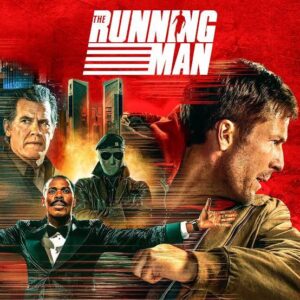
Truth to tell (an ‘interesting’ way to start this piece), The Running Man – as a film or book – has been pretty much dead for twenty years or so. A minor Bachman book, even when it was published back in 1983, it was (and still is) frequently confused with 1979’s The Long Walk, and regardless – like the other early Bachman books – it wasn’t “Stephen King-y” enough at the time, not long enough or filled with classic monsters or jump scares. Any potential it might have displayed was pretty efficiently quashed after Paul Michael Glazer’s noisome and loathsome 1987 film with Arnold Schwarzenegger and Richard Dawson (Hey, remember Richard Dawson? One of those cultural icons of the 80’s already lost to antiquity)p. Today, it ranks high on the list of King movies that everybody’s heard of/about, but few have actually seen (though it is still currently all over the place, like Paramount+ and Roku, as well as Amazon for a paltry $1.99).
Fast forward to the 21st century, and the truly revolutionary writer/director Edgar Wright (of Last Night in Soho, Baby Driver, Scott Pilgrim vs. the World, and Shaun of the Dead, plus the other Cornetto movies) somehow convinced Paramount to let him remake The Running Man as an entirely different film…
His vision is much closer to the dour, dystopian novel than the glitzy nonsense of 1987. How could those hapless execs possibly have known that Wright would turn in an open call for armed rebellion against precisely the kind of monolithic mediautocracy that Paramount itself is part of today?
The Running Man is, by far, one of the most political films in the Dark Multiverse, even more so than its brother-in-dystopia, The Long Walk. If you haven’t seen it yet, do so now. It’s currently available on Amazon and Apple for the ridiculous rental price of $19.99, but it’ll be streaming on Paramount+, its daddy’s hometown, before you know it. You might be astonished to discover how good and – amazingly – how deep it really goes.
As a full-on action pic, it is damn good. Glen Powell is a convincing lead, physically and emotionally, from the very beginning, showing brains and brawn in equal and often surprising measure. (And am I the only one who thinks this guy should be the next Bruce Wayne? I mean, come on.) The screenplay is packed chockablock with the kind of irresistible relentlessness you find in the best thrillers, setting up its deceptively simple premise in the first, what, four or five minutes and then playing it out, step after unavoidable step, as we learn more about the victim/hero Ben Richards, his community, and his world. Oh, it twists and turns – for sure! – but it never breaks its own rules, the ones it sets up at the outset, as so many other poorly made thrillers do. And even the callbacks and Chekovian guns are placed so casually and artfully that some of them will slip past even the most cynical and experienced viewer (well… me, at least).
But the most surprising aspect of The Running Man is its underlying message – the one that rises to the top in the last act: that modern, pervasive unitary media can be fused to a fascist government (a word, and correct me if I’m wrong, that is never used in the movie) and can be used as a weapon, to enforce docility and hopelessness by poisoning the bread and mutating the circuses of pop culture, to the deep detriment of us all.
It is beyond ironic that the anti-mass-media, anti-authoritarian message of Wright’s movie is embedded in an action picture from no less a mass-market monolith than Paramount Pictures – the quintessential example of an increasingly evil, weak, and hypocritical monster in its own right. But here it is, biting the hand that feeds it – almost literally – until it draws blood.
It’s also worth noting that The Running Man did not do well at the box office, recouping barely half its pretty huge budget. It did bring in more than the other three King movies that premiered theatrically in the same year – Life of Chuck, The Long Walk, and The Monkey – but it will probably pencil out as the last profitable of the lot, since its budget exceeded $110 million, while the others cost far less. I’m not quite sure why; the early critics seemed unimpressed in spite of some strong action sequences and sly cameos/supporting work by the likes of Michael Cera, Lee Pace, James R. Macey, and Josh Broline — Thanos himself – as the all-too-handsome Manipulator in Chief.
But all is not lost. There’s still streaming to come. And these days, movies that do poorly on the wide screen don’t necessarily do as poorly on Netflix et al. And let’s be honest: the number of people lining up at the theater to see anything but Wicked this summer was pretty damn small. Why spend fifty bucks for two tickets and a bucket of bad popcorn even on a King actioner, when you know it’ll be on your home screen in a couple of months for ‘free’?
In fact, preliminary figures from the streamers — and just the VOD (you now: View on Demand) numbers — are already proving the point. According to FlixPatrol and Collider (lots of details there for your data junkies), The Running Man was the number one movie on the domestic Apple TV rankings the week it debuted (that looks wrong), outpacing new releases such as Now You See Me: Now You Don’t and Sisu: Road to Revenge. And when it pops up on Paramount+ or wherever, we might see an even stronger revival in interest for this raucous, gleefully violent, and angry little picture.
What an interesting end of 2025, and beginning to 2026…
Connective (brain) tissue: yes, there are plenty of cute li’l Multiversal references in here, like the prominent inclusion of a storefront called Tabby’s Diner, a possible appearance of The Jade of the Orient, the Chinese restaurant from It, a wildly destructive detour to Derry, Maine to blow some things up real good, and more. It’s clearly an act of King-love from Wright, and welcome by all the Tower-obsessed freaks among us. This article in SlashFilm and this one from comicbook.com both do a pretty good job of pointing them out. And it’s worth mentioning that Wright does a nice job of giving us the original, ultradark ending of the novel – the murder of Ben Richards’ family and his own death when he flies the plane into the Network building – and a far more dramatically satisfying – and brutal – ending of his own. A neat trick. In fact, ComingSoon.net has a way-above-average interview with Mr. Wright about the changes he made, both why and how, right here. Far superior to the normal PR/press junket stuff.